When I shut up heaven and there is no rain, or command the locusts to devour the land, or send pestilence among My people, if My people who are called by My name will humble themselves, and pray and seek My face, and turn from their wicked ways, then I will hear from heaven, and will forgive their sin and heal their land. (2 Chronicles 7:13-14 NKJV)
The first time we encountered this verse in a meaningful way was in 1976 in preparation for a large gathering to celebrate the 200th anniversary of our nation. As you know, this year marks the 250th anniversary – so we’ve been acquainted with the promises in 2 Chronicles 7:13-14 for fifty years! Like many, God has kept this verse in the forefront of our prayers and has taught us many things – but our land has yet to be healed. Perhaps, it would be a good idea to explore it a bit more detail…In context, this is a promise that God made to Solomon, upon the completion of the Temple and the king’s personal residence in Jerusalem. Essentially, it was a set of instructions that marked the path back to God, when sin brings judgment on the nation. It is also a pattern that we can use for our own sanctification!
Notice, that verse 13 begins with “when” – not if. God knew they’d need this information, because sinners sin. His long history with Abraham and his descendants has amply proven this to be true, as well. So, in His great love and mercy, God provided the way back to Him, as well as the motivation to do so. Notice, also, who sends the drought and the locusts and the pestilence – GOD.
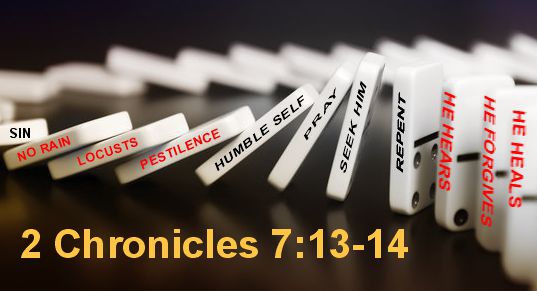
While verse 13 begins with “when,” verse 14 begins with “if.” God’s healing is not automatic; it is conditional upon four things that will restore fellowship with Him that is broken by our personal and national sin. To make things right, God required His people to humble themselves, pray, seek His face, and depart from their wicked ways. The illustration (above) tells us how – and that could be the key to seeing this promise of healing become a reality.
They say that a picture is worth a thousand words, so I’ll cut to the chase: The reason these elements are depicted as dominoes is because that’s how they seem to work. For clarity’s sake, the dominoes are labeled in red for what God does and in black for what we do. His promises here are conditional. That means that we can trust Him to do what He says – if we do what He tells us. If we (1) humble ourselves, (2) pray, (3) seek His face, and (4) turn from our evil ways, then He will (1) hear from heaven, (2) forgive our sins, (3) and heal our land. On the surface, it seems perfectly clear: We do those four things, and He promises to do those three things. His part is a given, if we do ours. So, what’s the hold-up? Probably ours! So, let’s unpack our part of the equation and see if it helps…
STEP 1: We must humble ourselves.
Humbling ourselves is the first step toward healing our nation – and, arguably, the most important. If this domino doesn’t fall, neither will the others. So, what exactly does this mean and how do we do it? Obviously, we must forsake our pride to humble ourselves; that’s a given, but not to take for granted. To humble ourselves, we must first admit that we can’t… We can’t fix our nation any more than we could fix our own sin problem! Ultimately, our nation needs a Savior who rescues the helpless, not a president or a government or a robust economy or a world-class military or any of the other things that man can do! (Romans 5:5; Psalm 20:7; Isaiah 31:1)
Since pride is a key element of the fallen nature, along with rebellion, our inclination may be to rely upon ourselves, other humans, or man-made solutions to solve our problems. This form of self-reliance runs deep in our culture and needs to be cleansed from our hearts to “ascend the hill of the Lord.” (Psalm 24:3-5) As believers, we have an imputed righteousness in Christ, but our personal holiness is a process of pruning and purging. So, we – who are somewhere between who we were and who we shall be – must take this step seriously and learn to “walk humbly with our God.” (Micah 6:8).
Simply put: Humility is necessary to our sanctification, and the transformation of the Church is necessary to the healing of our land. That is why this passage in 2 Chronicles 7 is addressed to those who are “called by His name.” While initially given to the house of Israel, those who are in Christ can also claim it, having been grafted into their legacy. Both James and Peter also exhort us to humble ourselves to draw near to God, because He still “resists the proud but gives grace to the humble.” (James 4:6; 1Peter 5:5) If we humble ourselves, not only will our land be healed but we will be “exalted in due time.” (James 4:10; 1Peter 5:6) This was the same path Jesus walked – and so must we. (Philippians 2:5-11)
STEP 2: Pray.
Okay…so humility is our starting point, and that should lead us directly into prayer! In ancient Hebrew, the word, ‘pray’ meant to appeal to authority, to intercede, to ask for mercy. So, when we realize that our individual and collective ills have resulted from turning away from God – and in our utter helplessness, we become desperate for Him to step in and fix things – prayer is the appropriate response. When we reach this depth of humility, we are ready to “come boldly to the throne of grace, that we may obtain mercy and find grace to help in time of need.” (Hebrews 4:16) But how? How should we pray for our nation to be healed? That sounds like a tall order!
Perhaps Daniel can help us here…
In Daniel 9:4-19, we find him interceding for Israel. To do so, he confesses his own sins and those of his nation – along with God’s righteousness. In essence, he says, “Oh God, you are right and we are wrong…so very wrong!” Since Daniel’s situation and ours have much in common, his prayer is a great example. In brief, God made a covenant with the Hebrews to give them the Promised Land, as long as they honored Him in it. If not, out they go – and that’s exactly what happened. According to Jeremiah, this judgment would last for 70 years, and the time was almost up. So, Daniel prayed, activating these promises in 2 Chronicles 7, and eventually, his people were eventually restored to the Land!
Did you know that we, too, have a covenant with God? It’s not quite like Israel’s, because God did not initiate it directly. We did. However, there is ample evidence that He agreed to our desire to covenant with Him to be His nation. From its inception, God has been faithful to bless America, but (like Israel) we have grown unfaithful to Him. We have overtly and systematically tried to erase Him from the public square since the 1960’s! In essence, through our laws, courts, media, arts, education – and yes, even in our churches – we have told Him that He is no longer in charge; we are. We will determine right and wrong – not Him. So, it’s no wonder that we are in a mess!
Perhaps, a little American history may help us to understand that we did not just base our government on Judeo-Christian ethics, but also on a covenant forged in prayer and proclamation…
Our earliest record of this covenant dates back to April 29, 1607, when Reverend Robert Hunt dedicated the land that would become the United States of America to God by planting a wooden cross at Cape Henry, Virginia. There, he prayed for it to become a land for the Gospel. On November 11, 1620, the first governing document of the New World, the Mayflower Compact of the Plymouth Colony in Massachusetts, was signed, dedicating it to the Glory of God and the advancement of the Christian faith. And then, on April 30, 1789, in New York City (then our capital), George Washington was inaugurated as the first president of the newly formed nation. During the ceremony, he is cited as making a covenant with God, laying his hand a Bible open to Genesis, where God made a covenant with Abraham. As President, he promised to uphold it, saying, “So, help me God.” Following the ceremony, he and the members of Congress went to St. Paul’s Chapel and had a prayer meeting in which they personally dedicated the nation and themselves to Him, formally committing us to be a “nation under God.”
Unfortunately, we have fallen far from our auspicious beginnings… We are the ones who asked God to be our God – and then we (as a nation) have rejected Him by officially and unofficially transgressing His laws and ignoring His Word! So, prayer is certainly in order, and Daniel’s model suits our situation.
Therefore, to intercede for our apostate nation, we must humbly come before God as penitent covenant breakers and ask for His mercy. It is not just that we have sinned – but that we have sinned against HIM, the One who has been nothing but good to us. Like Daniel, we too need to be specific, to name our sins and the sins of our nation. We need to take responsibility for them, including the sins of the Church – prayerlessness being at the top of the list. Like Dainiel, we should say, “…all this disaster has come upon us; yet we have not made our prayer before the LORD our God, that we might turn from our iniquities and understand [His] truth.” (Daniel 9:13)
Certainly, we owe Him that much. Whether or not we have been personally involved in our Church or political sins, we are still part of this nation – and that’s good news. Daniel was a righteous man in the midst of apostate Israel, but it was still his nation. He could intimately identify with the national humiliation, as revealed in the light of God’s holiness. Because we are American Christians, we are called to intercede for our land, like Daniel did. In Christ, we are also righteous, because He “became sin for us, that we might become the righteousness of God in Him.” (2 Corinthians 5:21) Thankfully, God is still searching for those who can humbly stand in the gap for their land, asking for mercy instead of judgment. (Ezekiel 22:30) But, if the Church won’t do it, who will? So, yes – pray, and pray boldly, according to His Word!
Okay, we have humbled ourselves and prayed! Mission accomplished, right? Wrong. While it would be easy to think so, since prayer is such a powerful step – but this isn’t what God told Solomon. If the Church stops here, we will only be halfway there. So, let’s consider the next step in the process…
STEP 3: Seek His face.
If you have hung around church long enough, you may have heard this expression – or maybe not – but it is in the Bible. (Also see 1 Chronicles 16:11 and Psalm 105:4.) God definitely wants us to seek His face, but what does it really mean – and how do we do it? Isn’t this just another form of prayer? Well, yes, it primarily happens through prayer, but seeking His face is different than “seeking His hand” or making requests. This type of prayer isn’t supplication or intercession. It’s not standing in the gap; it is communion. Seeking His face is a very intimate type of prayer that primarily promotes our relationship with Him. It’s not asking; it’s aligning – and it transforms us from the depths of our being.
Even though, we are exhorted to seek God’s face, His people seemed to think that they would die, if they saw His face! Their idea (primarily) reflects their understanding of His holiness and our unholiness more than the reality of the matter. For instance, Jacob wrestled with “a Man” the night before he was to meet his brother, Esau after a long and difficult estrangement. When the Man left, Jacob realized that he had actually wrestled with God, Himself! So, he named the place of his blessing ‘Peniel’ – which means “face of God,” saying, “For I have seen God face to face, and my life is preserved.” (Genesis 32:30) Actually, his real life had just begun, because the Man changed his name from “supplanter” to “God prevails” – from Jacob to Israel.
This is not an isolated incident. Enoch, the father of Methuselah, had to be really close to God, since we are told that he “walked with God; and he was not, for God took him.” (Genesis 5:24) Moses had that kind of relationship with Yahweh, meeting with Him in the Tabernacle and speaking with him “face to face, as a man speaks to his friend” (Exodus 33:11) – “plainly, and not in dark sayings and [seeing] the form of the Lord.” (Numbers 12:8) David was “a man after [God’s] own heart” who had an intimate relationship with Him. (Acts 13:22) Likely, he grew to know God as a shepherd boy and continued in that fellowship with Him throughout his lifetime. You can find much of his relationship with God recorded in the Psalms!
Ultimately, God showed us “His face” in the person of His Son, Jesus of Nazareth! Scripture tells us that “He is the image of the invisible God, the firstborn [prototype] over all creation.” (Colossians 1:15) Jesus, Himself, told His disciples, “He who has seen me has seen the Father.” (John 14:9) So, yes, we are to seek His face!
Unfortunately, there is much confusion about this, perhaps from a lack of knowledge. Even now, many think that they will only “see God face to face” when they die, when they get eternal life. Oh, how very far is that from the truth! While we only see dimly now and know in part, we will see totally then and know Him even as we are known. (1 Corinthians 13:12) No doubt, that will be utterly amazing, but we do not have to wait to have eternal life! That is what salvation is all about: Having an intimate and personal relationship with Him here that continues forever. It is the abundant life we receive when we are born again, spiritually, to personally experience and grow in the knowledge of “the only true God, and Jesus Christ!” (John 17:3) Paul majored on knowing God (Philippians 33:10) – and we can, too.
This step invites us to go beyond transactional prayer to transformational. In Christ, under the New Covenant, that kind of face-to-face relationship is available to all! (Hebrews 8:11)
So, when we seek God’s face, we come to Him for HIM, to know Him, to fellowship with Him, and to relate to Him, personally and intimately. We come transparent – and He does, too. We pray, yes, but we also search the Scriptures with the Holy Spirit’s leading. He is the One who reveals Jesus to us! (John 14:26, 15:26, 16:13-15; 1 Corinthians 2:10-13) When we come to Him, even with our most trivial thoughts, feelings, and desires, we know we are welcomed into a safe place. Also when we come with our deepest self exposed to His love and mercy, in those times of true communion, we seek His face. We come, pouring out our heart before the Lord in holy reverence and find refuge. (Psalm 62:8) It is this step that prepares us for the next…
STEP 4: Turn from our wicked ways.
So, when we seek His face with our whole heart, we will encounter Him (Jeremiah 29:13-14a) – and beholding Him be transformed. This causes us to be “changed into [His] image from glory to glory, just as by the Spirit of the Lord.” (2 Corinthians 3:18) That is the grace-filled basis for turning from our wicked ways. This fourth step is not beyond our reach, when we learn to access His grace! Here’s how it works…
Through humbling ourselves, praying, and seeking His face, we grow closer to God. When we do, we learn what He likes and what He doesn’t like, according to His own standards and kingdom culture. (Isaiah 55:8-9) When we encounter Him – His thoughts, His feelings, and His desires – we see just how very different we are. At that point, we can appreciate the question the Lord asked Amos, “Can two walk together, unless they are agreed?” (Amos 3:3) The answer, of course, is that they can’t. Someone has to change – and that would be us.
So, when we see ourselves in light of His great love and holiness, we must bow the knee. The only appropriate response is to submit ourselves to Him – what we think, what we feel, and what we want. It is at this juncture that communion turns into conviction of sin, and that turns into redemption through the gift of repentance. Oh, how good is our Savior to grant us the godly sorrow that produces a repentance not to be repented of! (Romans 2:4; 2 Corinthians 7:10) This is where His work of sanctification gains traction in our heart.
In other words, when we repent at the heart level, we turn from our wicked ways and will not turn back to them – by His grace. Through faith, we know that when “we confess our sins, He is faithful and just to forgive our sins and to cleanses us from all unrighteousness.” (1 John 1:9) God, in His amazing mercy reveals our sins to us and gives us the gift of repentance, so He can forgive – and cleanse us from the unrighteousness in our heart! Jesus’ blood is not a band-aid that simply covers the wound, it is the balm of Gilead that removes the disease.
Though our heart is desperately wicked, God has promised to give us a new one in the New Covenant. (Jeremiah 17:9; Ezekiel 36:26) That is the Lord’s endgame in the process, that we become “new creatures” in Him. (2 Corinthians 5:19) This is why we can say, with Paul, that “Truly, deep within my true identity, I love to do what pleases God.” (Romans 7:22 TPT) When we invite Him to search our hearts for wicked ways, He always seems to find them – but He also leads us “in the way everlasting.” (Psalm 139:23-24)
Once we embrace the nature of the requirements in 2 Chronicles 7, as dominoes that must fall into each other, we can joyfully “lay aside every weight and the sin which so easily ensnares us, [to] run the race set before us, looking unto Jesus, the author and finisher of our faith.” (Hebrews 12:1b-2a) The Church can make a difference – today, even in our nation – if we will learn to walk in His Spirit by faith through His enabling grace. So, let us “work out our own salvation [and the healing of our nation] with fear and trembling, for it is God who is at work in us to will and to do for His good pleasure.” (Philippians 2:12b-13)